English
 中文
中文 Español
 русский
 français
 português
 العربية
 Deutsch
 italiano
 한국어
한국어 Polska
×
In rock drilling, not every hole is drilled to its final diameter in a single pass. For larger-diameter boreholes, the most efficient approach is often a two-stage process: drill a smaller pilot hole first, then enlarge it to the required size. This second stage is called reaming.
Reaming is a critical technique in mining, tunneling, quarrying, and construction. It allows operators to achieve precise hole diameters, improve blasting efficiency, reduce equipment strain, and extend tool life. This article explains what reaming is, how the process works, the tools involved, and where it is applied.
Reaming is the process of enlarging an existing borehole to a larger diameter using a specialized cutting tool called a reaming bit (also known as a reamer bit, hole opener, or reamer). Unlike a standard button bit that creates the initial hole from solid rock, a reaming bit follows a pre-drilled pilot hole and expands it to the final required diameter.
The reaming process typically follows a two-pass sequence:
Pilot pass: A smaller-diameter bit drills a pilot hole to establish alignment and straightness.
Reaming pass: A larger reaming bit follows the pilot hole and enlarges it to the final diameter.
This two-stage approach offers several advantages: better hole straightness (the pilot hole guides the reaming bit), reduced torque demand on drilling equipment, extended tool life by distributing wear across two separate tools, and the ability to achieve larger diameters than a single-pass bit could handle.
The reaming process follows a sequence:
Step 1: Pilot hole drilling. A standard button bit drills a pilot hole to a specified depth. The pilot hole diameter is typically smaller than the final desired diameter—often 20–40 mm less.
Step 2: Bit change. The pilot bit is removed from the drill string and replaced with a reaming bit of the appropriate diameter and thread type.
Step 3: Reaming pass. The reaming bit follows the pilot hole as it enlarges the borehole to the final diameter. Depending on the application, the reaming bit may be pushed downward or—in raise boring applications—pulled upward through the hole.
Step 4: Cuttings removal. Flushing air or water clears rock cuttings from the hole to prevent bit seizure and maintain penetration rates.
In raise boring, the process is inverted: a small-diameter pilot hole is drilled top-down between two levels, then a reamer head equipped with raise cutters is connected to the drill string and pulled upward while rotating, enlarging the pilot hole to a circular shaft. This bottom-up reaming process cannot be observed directly, making predictive control methods essential.
Reaming bits for top hammer drilling fall into several categories:
Pilot reaming bits are designed to create the initial smaller-diameter hole that guides the subsequent reaming pass. They prioritize precision and straightness.
Key features:
Compact front section with carbide buttons concentrated for initial penetration
Often includes a pilot adapter for enhanced guidance
Common thread systems: R25, R32, T38, T45, T51
Primary applications:
Establishing accurate alignment in long-hole drilling
Ideal for fractured rock where deviation can cause significant issues
Raise boring starts and precision benching in quarries
Dome reaming bits have a distinctive rounded, dome-shaped head that allows for wider cutting diameter and aggressive material removal.
Key features:
Larger peripheral carbide buttons for efficient enlargement
Domed profile for even impact distribution and reduced vibration
Typical diameters ranging from 76 mm to 152 mm
Primary applications:
Enlarging the pilot hole to the final required size
Suited for abrasive or hard rock conditions needing high volume removal
Slot raises, ventilation shafts, and large-diameter holes in underground mining
A specialized variant, the retrac reaming bit, addresses a common challenge in reaming operations: bit retrieval. When a standard reaming bit reaches the bottom of the hole, loose rock debris often causes it to seize when being pulled back.
Retrac reaming bits feature cutting fins in the rear section that push rock chips out of the way during extraction. These fins effectively force out trapped rock chips when the drill string is pulled from the blast hole, resulting in more efficient reaming operations in underground drilling. The design was developed specifically to address the challenge of retrieving reaming bits in tunneling, mining, and underground construction operations.
Selecting the right reaming bit requires consideration of several factors:
| Factor | Consideration |
| Final borehole diameter | Project requirements (explosive charge size, casing needs, ventilation flow) |
| Thread type | Match to drifter, rods, and couplings (R32 for lighter rigs, T45/T51 for heavier duty) |
| Rock formation | Abrasive/hard rock requires larger peripheral buttons; fractured/soft rock prioritizes straightness |
| Drilling stage | Pilot pass uses smaller diameter; reaming pass uses larger |
| Penetration rate vs. tool life | Oversized bits increase torque demands; undersized reduce efficiency |
In underground blasting operations, reaming bits enlarge selected blast holes to larger diameters for effective rock fragmentation. After blast holes are drilled in the tunnel face with diameters ranging from 43 to 51 mm, certain holes in the blast pattern—typically the empty or "cut" holes—are enlarged to 76–102 mm using a reaming bit. These enlarged holes are left unloaded (no explosives are placed in them), allowing the surrounding rock formation to implode more effectively during detonation.
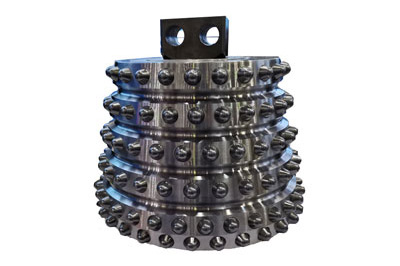
Raise boring is a two-step process that relies heavily on reaming. A small-diameter pilot hole is drilled top-down between two levels. Then, a reamer head equipped with raise cutters is connected to the drill string and pulled upward while rotating, enlarging the pilot hole to a circular shaft. The process is used to construct underground shafts in mines and other underground infrastructures.
In quarry bench drilling, reaming bits are used to achieve precise blast hole diameters for controlled rock fragmentation. Common configurations include R32 or T38 threads with final diameters of 89–102 mm.
Reaming is also applied in foundation drilling, ventilation shaft construction, and other civil engineering projects requiring large-diameter boreholes with precise alignment.
Improved hole straightness: The pilot hole guides the reaming bit, reducing deviation
Reduced equipment strain: Two-pass drilling distributes torque and impact loads
Extended tool life: Wear is distributed across pilot and reaming tools
Larger diameters: Enables boreholes beyond the capacity of single-pass bits
Better blasting results: Enlarged empty holes improve rock fragmentation in underground blasting
Two-pass process: Requires additional time for bit changes and a second drilling pass
Higher tooling costs: Requires both pilot bits and reaming bits
Retrieval challenges: Standard reaming bits can seize in the hole (addressed by retrac designs)
Not suitable for all formations: May be less efficient in soft or highly fractured ground
Reaming is not an alternative to standard drilling—it is a complementary technique that enables operators to achieve larger, straighter, and more precise boreholes than would be possible with a single-pass approach. Whether in underground mining, tunneling, quarrying, or raise boring, the two-pass pilot-and-ream sequence delivers consistent results in challenging rock conditions.
The key takeaways:
Reaming enlarges, not creates—it follows a pilot hole
Pilot bits establish alignment; dome bits do the heavy enlargement
Retrac designs solve retrieval problems in demanding conditions
Proper selection of diameter, thread type, and button configuration is essential
When you need large-diameter holes with precision and efficiency, reaming is the proven solution.
Q1: What is the difference between a button bit and a reaming bit?
A button bit creates the initial hole from solid rock. A reaming bit enlarges an existing pilot hole to a larger diameter. They serve complementary roles: button bits are hole creators; reamer bits are hole enlargers.
Read more: Button Bit vs Reamer Bit: Choosing the Right Tool for Efficient Rock Drilling
Q2: What are the two main types of reaming bits in top hammer drilling?
The two primary types are pilot reaming bits and dome reaming bits. Pilot bits create the initial smaller hole for alignment and straightness. Dome bits follow to expand the hole aggressively while maintaining smooth walls.
Read more: Pilot Reaming Bit vs Dome Reaming Bit: Understanding the Differences in Top Hammer Drilling
Q3: Why are reamed holes left unloaded in blasting operations?
In underground blasting, certain holes in the blast pattern are enlarged with a reaming bit and left unloaded. During detonation, these empty voids allow the surrounding rock formation to implode more effectively, resulting in superior rock fragmentation and more efficient blasting patterns.
Q4: What is a retrac reaming bit and when should it be used?
A retrac reaming bit features cutting fins in the rear section that push rock chips out of the way during retrieval. It should be used when standard reaming bits tend to seize in the hole due to loose rock debris, particularly in underground face drilling operations.
Q5: What hole diameters are typical for reaming bits?
Typical reaming bit diameters range from 76 mm to 152 mm. Common sizes include 76 mm, 89 mm, 102 mm, 115 mm, 127 mm, and 152 mm, depending on the thread type and application.
Read more: How to Choose Reaming Bit Sizes in Top Hammer Drilling
"Rockmore launches retrac reaming bit" – Pit & Quarry, November 2020. https://stage.pitandquarry.com/rockmore-launches-retrac-reaming-bit/
"Rockmore International Unveils New Reaming Bit" – The Driller, November 2020. https://www.thedriller.com/articles/92083-rockmore-international-unveils-new-reaming-bit
"Predictive Control Method of Reaming up in the Raise Boring Process Using Kernel Based Extreme Learning Machine" – OUCI. https://ouci.dntb.gov.ua
"Research on process and key technologies of raise boring" – mtkxjs.com.cn, 2023. https://www.mtkxjs.com.cn
"Vibration based fatigue assessment in Raise Boring" – Taylor & Francis (Tunnelling). https://www.taylorfrancis.com
"Key technologies of drilling process with raise boring method" – ScienceDirect, 2015. https://www.sciencedirect.com
"Study on force in raise boring tool under reaming process and engineering application" – China Mining Magazine, 2023. https://www.chinaminingmagazine.com
This is the first one.

Litian is a professional manufacturer focused on the production of rock drilling tools and excavation tools.
Learn More >